The short answer: A software company that just raised a Series A or B is about to add experienced reps to a sales team with no onboarding program, no written playbook, and nobody whose job is to build either. With fractional sales enablement, you contract an experienced enablement leader for a set number of days each week to build those programs, and they can start right away because there's no full-time search to run. The program gets built in the first 90 days, and somewhere between month nine and month twelve you hire a full-time enablement leader to take over something that already runs.
The board approved the plan, and the plan adds several account executives to the sales team over the next twelve months. Recruiting is already moving. What almost nobody has figured out is who will turn those new hires into reps who close, because up to now the answer has been the founder, the VP of Sales, and whichever top rep had a free afternoon. That works with four reps. It stops working at eight or ten.
What is fractional sales enablement?
Fractional sales enablement is a senior enablement leader working with your sales team part-time, on contract, to build and run the programs a full-time enablement team would own: onboarding, the sales playbook, certification, and coaching support for managers. You get the experience of someone who has built these programs before, without the salary or the search. I cover the model in more detail in What Is Fractional Sales Enablement?
What breaks in a software sales team after a funding round?
Two things break as headcount grows: reps stop selling the same way, and new hires take too long to get productive. I call these the execution gap and the ramp tax.
Series A and B software companies don't hire rookies. You're bringing in experienced account executives, many of them from bigger software companies, and those people are used to a playbook, a defined onboarding program, and an enablement team that answers their questions. They show up at your company and find a shared drive, a handful of recorded demos, and a Slack channel. Good reps can sell without structure for a while, but each of them will do it their own way.
That's the execution gap. Your best two reps know how to run a discovery call, when to bring in a sales engineer, and what to say when a buyer pushes back on price. None of it is written down, so every new hire fills the hole with the pitch that worked at their last company. Funding makes the gap wider with every offer letter you send.
The ramp tax is the cost of slow onboarding. An experienced AE still has to learn your product, your buyer, and your competitors, and that can take six months or more. You pay the rep a full salary the whole time, and the leads and accounts you hand them during those months close at a lower rate than they would with a fully ramped rep. With one or two hires, you can absorb that. With five or six, it's probably the biggest cost in the plan that nobody put a number on. You can put your own number on it with the ramp calculator.
AI is the third piece. If your pitch to investors included a sales team that gets more efficient with AI, your reps now need specific workflows and training to make that true.
Should you hire a full-time Head of Enablement right after funding?
In most cases, I'd wait nine to twelve months. A senior enablement leader is a six-figure salary and a search that can eat a full quarter, which is a quarter where your new reps are ramping with nothing built for them. The candidates who fit a Series A budget are often good at running a program that exists but less proven at building one from a blank page.
The work in front of you right now is build work. Once the program exists, running it is a different job, and a much easier one to hire for. I compare the two options side by side in Fractional vs. Full-Time Sales Enablement.
What does fractional sales enablement do in the first 90 days?
The first 90 days are for building the playbook, the onboarding program, certification, and a small set of AI workflows. Here is roughly how I spend that quarter with a newly funded software team:
- I sit in on calls and demos and interview your top reps, then turn what they know into a sales playbook the whole team works from.
- I build milestone-based sales onboarding, so every new hire and their manager know what revenue-ready means at day 30 and day 60.
- I set up certification, so a rep proves they can run discovery and a demo before they take calls alone.
- I pick two or three AI workflows that remove real grunt work, like call prep and follow-up emails, and I train the team on exactly those.
When I led sales enablement at Jama Software and Medallia, we shortened new-rep ramp by 20%. Run that against your own plan. If your ramp is nine months, 20% is about eight weeks of selling time back per rep, and across five new hires that adds up to roughly nine months of quota-carrying time you'd otherwise never see.
What happens from month three through month twelve?
From month three on, the program runs on real hiring classes, gets measured and tuned, and is handed to a full-time enablement leader you hire somewhere between month nine and month twelve.
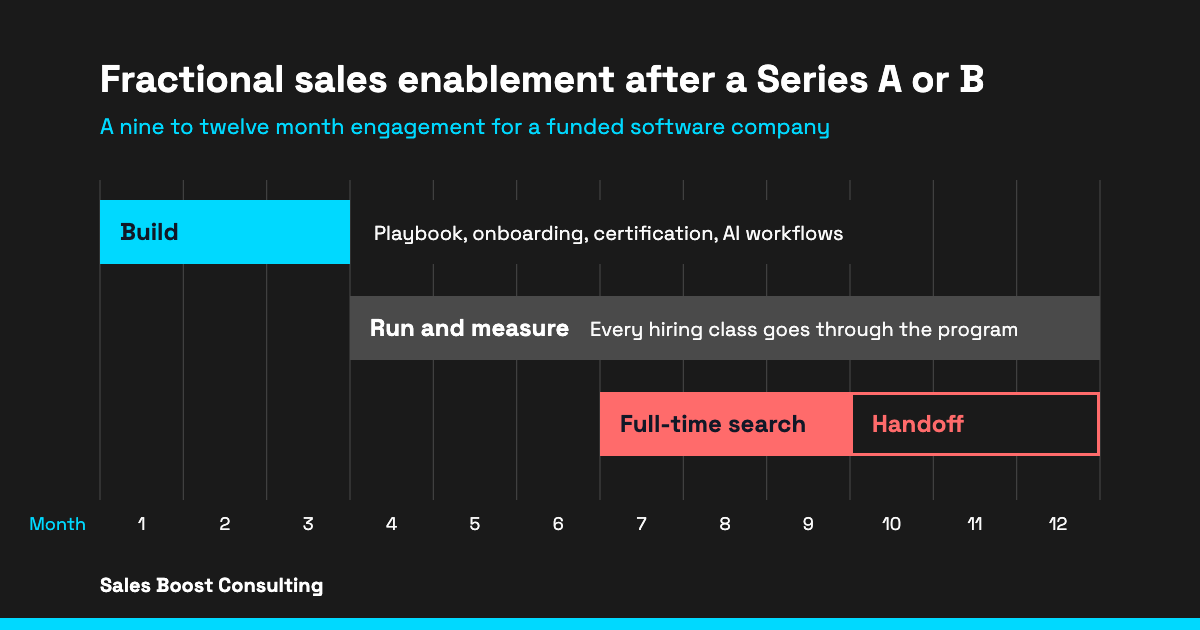
I run each new cohort through onboarding and certification, and I track their time to first deal against the reps you hired before the program existed. Whatever isn't working gets fixed before the next class starts. I also work with your frontline managers on a coaching rhythm, so the playbook shows up in pipeline reviews and one-on-ones, and I update it when you add a product or change pricing.
Around month six, we start the search for your full-time enablement hire. I write the job description from the work the role requires at your company, help you interview, and overlap with the person you pick so they take over a program that already runs and has results behind it. Depending on how long the search takes, the handoff lands between month nine and month twelve. That hire is easier to make at that point than it was at month one, because you now know what the job is and you're hiring someone to run and grow a system they can see.
I've watched this work at Series B startups and at companies doing a billion dollars. Timing matters more than company size, because every hiring class that starts before the program exists ramps the slow way, and you pay the ramp tax on each one.
Frequently asked questions
When should a funded software company bring in fractional sales enablement?
Bring it in as soon as the hiring plan is approved, and ideally before the first new class of reps starts. Every rep who starts before onboarding and the playbook exist ramps without them.
How long does a fractional sales enablement engagement last?
For a newly funded software company, plan on nine to twelve months. The first three are for building, and the rest are for running the program, measuring it, and handing it to a full-time hire.
How much does fractional sales enablement cost?
My engagements with funded software companies start at $7,500 a month, and the price goes up from there based on how many days a week you need and how much has to be built. A full-time enablement director costs about $180,000 a year once you add bonus and benefits, and you pay that after a search that can take a quarter.
How much can fractional sales enablement cut ramp time?
When I led sales enablement at Jama Software and Medallia, we shortened new-rep ramp by 20%. On a nine-month ramp, that is about eight weeks of selling time back for each new rep.
When should we hire a full-time sales enablement leader?
Start the search around month six of the engagement, once the onboarding program and playbook are running and you have ramp data from at least one hiring class. The fractional leader helps write the job description, interview candidates, and hand the program over.
What is the difference between fractional and full-time sales enablement?
A fractional leader works part-time on contract and is usually brought in to build the program. A full-time leader is an employee who owns it for the long run. Most funded software companies need the build first.
Talk through your hiring plan
If you've closed a round in the last six months and your hiring plan is ahead of your onboarding plan, book a discovery call. Bring the hiring plan, and I'll show you where the ramp tax is going to hit first. You can also read more about how Fractional Sales Enablement works at Sales Boost Consulting.

About the author: Matt Payne is the founder of Sales Boost Consulting, a Portland, Oregon firm that provides fractional sales enablement for software companies. He has spent 25 years in sales, sales training, and enablement, and he led enablement inside Medallia, Jama Software, and Teradata before going fractional. He builds sales onboarding programs and playbooks, and he trains sales teams on practical AI workflows. More about Matt
Related: How to Shorten Sales Rep Ramp Time at a Software Company · Why Sales Leaders Should Hire Fractional Sales Enablement Professionals